Month: November 2025

  • Government has to write things down

    Words in speeches are one thing; delivering on those words is something else. 

    Thus far on ‘digital ID’ there has been one short speech by the Prime Minister and a few media interviews which mostly contradict each other. There’s also a mountain of papers from the Blair government-in-exile, and from other lobbyists wanting their thing.

    While commercial companies can do whatever they want and announce it later – because (mostly) no one cares – Government is different. 

    Government has to write things down. This takes time and effort. Government has to listen and hear how people respond in consultations, and think about what they say – or just ignore them all, if the consultation is a sham.

    (more…)
  • NO2ID comment on the first delay to the ID cards consultation

    Shortly after its initial announcement, Government decided “Digital ID cards” would include a physical card.

    Government has now realised that writing their consultation questions will take longer than they thought, and so has announced that the ID cards consultation is delayed into next year.

    On that point:

    Dear Ministers in the Starmer Government,

    Did spin from the ‘Blair Government-in-exile’ (and the civil service in residence) make you think ID cards were going to be easy?

    When you start to consider some of the topics the Blair Institute didn’t tell you about, NO2ID is always happy to talk through the details.

    If you’d like to get in touch, we’re at coordinator@no2id.uk

  • Child Benefit checks as the Cathedral-like Vision of “a New State”

    The HMRC Child Benefit debacle – first spotted in Northern Ireland, with tens of thousands of families across the UK being treated as fraudsters and denied money they are eligible for, based on deeply flawed Home Office data that wasn’t properly checked, as the law requires – starkly illustrates a far deeper problem with government (ab)use of our data. 

    While the current HMRC / Home Office tragedy is just the latest in a long line of examples, the underlying dynamic is clear; it’s evident in government communications too. 

    The powerful yearn to be remembered and the civil service strives to deliver what they are tasked with doing. Politicians in particular want something they will be remembered for – tearing down what they didn’t create to replace it with their ‘legacy’. The seductive lie of control encourages visions of policy cathedrals intended to glorify their time in power long after they’ve gone; edifices that often don’t outlast them by more than a year.

    Gordon Brown has his response to the 2008 financial crisis, George Osborne, austerity and omnishambles. Iain Duncan Smith has Universal Credit, Wes Streeting plans to decimate General Practice, and Tony Blair will forever have Iraq – and remains hell-bent on adding ID cards to that. 

    “Not invented here” matters to politicians more than most. The legacy state of ‘ID’ right now is a mix of providers across the public and private sectors, and a blanket refusal to allow the creation of ‘share codes’ – a ‘credential’ or ‘certificate’ that proves something about you, like a Clubcard confirms eligibility for discounts – which have long been government’s goal. 

    This is entirely a political decision. 

    The various “share codes” announced by the PM at the end of September (i.e. Right to Work and Right to Rent checks) could be delivered via existing ID providers, but a Home Office that wants to manage your identity will never approve something that allows others to build better digital services. Just as the Blair Institute assumes ID cards are a prerequisite for delivering anything they envisage, so the Home Office minimises assistance and services to anyone else running an ID system. 

    These are petty institutional games, not state building.

    “We have to build a new state and shut down the legacy state…” said Cabinet Minister Darren Jones, “…with digital ID making people’s experience of that new state fundamentally much better,” a Blair-serving, tone-deaf soundbite, misconceiving a Forth Bridge scale endeavour. The State is not something separate from the people it serves – as evidenced by the harm it causes time and again to those it overlooks or ignores – not something to be shut down on a whim. 

    Razing institutions to the ground to build new ones may seem attractive, but it’s not always even possible, much less wise. While reform is always possible, some reforms need reform after reform. 

    Those lusting for power want to reform the State in their own image, using the technology of the day. Democracy is, will and always has been about rebuilding the State for the emerging state of the world. Technology is used by power, or is deliberately chosen not to be used by power – whichever is more convenient.

    Reform(er)s often focus only on those things they care about, and neglect everything else, possibly so as to prevent another restart. And, in time, the names of those public services that leadership neglects become known as their scandals: NCC1, Carers Allowance, Child Benefit “fraud”, Windrush, Horizon and the sub-postmasters… 

    Once you shut down a service, it can be potentially impossible to restart it again – especially if you’ve sold off the buildings and made the staff redundant. (Palantir’s current worldwide ad campaign declares their services are “making Americans irreplaceable”, which is weird in the UK.

    Institutions use the technology how they want. 

    The Current Digital State

    Universal Credit is a “digital first” service, but there is still no digital service for the NCC1 form – that horrific edge case is still paper-only; the cold bureaucracy of trauma. Parents are put through pointless bureaucracy for free childcare because it ‘keeps the costs down’. The NHS National Data Opt Out requires you to use a digital service for yourself – but if you want to make the same choice for your children, you have to use a paper form and send that in.

    Institutions use the technology how they want. 

    HMRC uses Home Office records to strip honest people who haven’t left the country of Child Benefit for not returning to the country, because they never left! (That same data could be used to inform tax evasion and tax avoidance cases for people who are in the country more than they say – but that is a bit harder, so it’s ignored.)

    Politicians and their advisors came in to do a thing, having recognised or having been convinced that this change is important. They just have to hope there are no catastrophic consequences that they hadn’t considered which come due on their watch.

    It’s possible Wes Streeting didn’t mean to issue a legal Direction to NHS England that the NHS should lie to patients about him breaking the “pandemic only” promises about Covid data. It’s just what he did, because he was listening to those who would benefit from that broken promise.

    What the data is, and what the data isn’t

    The details will come out in the next few weeks, but the data the Home Office shared was not the data that HMRC thought it was. But the State did what the State does and used the most beneficial reading to make individual civil servants and politicians look good.

    HMRC wasn’t required to check other data sources, so it didn’t. (While you can receive Child Benefit without being in employment, working an hourly paid job at Tesco does strongly suggest that you haven’t left the country.)

    In a Database State driven by ID cards

    In the Database State, in a digital state linked by digital ID for “convenience” and “efficiency”, a finding by HMG that you had ‘moved abroad’ would not just automatically terminate your child benefit payments but also terminate your health care and ongoing medical treatments, terminate your repeat prescriptions and your GP registration, and remove you from waiting lists. 

    Some of that may be survivable, and some of that mess can be undone. Being taken off a waiting list can be reversed by adding you back, for example – but you are added to the back of the queue…

    Your medical records and medical notes have previously been excluded from such powers and such ‘secondary uses’, but our colleagues at medConfidential expect Wes Streeting to remove that exclusion and to include health data in the coming months when he weakens other protections there to prevent these types of mistake that can have real consequences for your health.

    Mr Streeting is also expected to remove your right to object to the Government using your medical records for any administrative purpose that they choose, as the TBI culture groupies at the just-launched “Data Alliance” want him to do.

    Many people want things to be the way they used to be; to put the world (and you) back to the way it seemed to be to them when they were a child. Others have delusions of grandeur and competence. “Take it or leave it” might be driving the TechBros and billionaire-backed influencers and their influencees right now, but while you can drive users who remain with your product, driving an electorate is a distinctly different proposition. 

  • Outside Downing Street

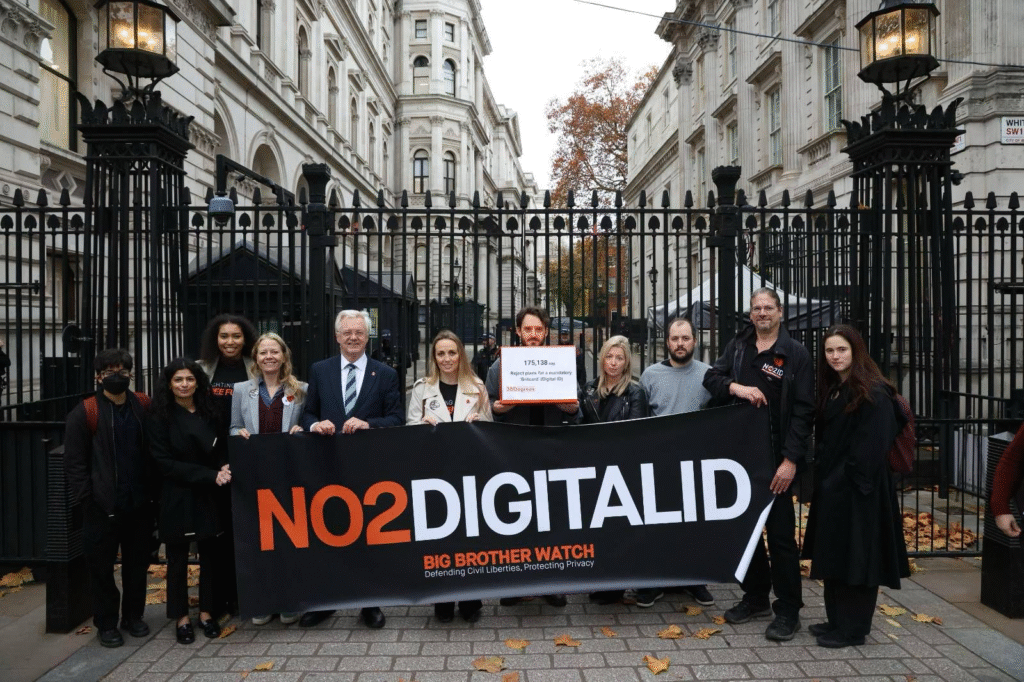
    NO2ID joined with our friends at Big Brother Watch, Liberty and the Migrants’ Rights Network, along with David Davis and Siân Berry to hand in 38 Degrees’ NO2DIGITALID petition to 10 Downing Street. (This was separate to the ongoing Parliamentary petition, which will have a Parliamentary debate on 8th December.)

    It was Remembrance Day, making the Government’s recent decision to promote its mandatory ID scheme with ‘Veteran ID cards’ seem even more tone-deaf. We did have identity cards in the UK during WWI and WWII, and very briefly under the last Labour Government – the Starmer Government might do well to recall the result of Blair’s ID ambitions last time…  

    If you would like someone from NO2ID to talk about the ID plans with your group or on your podcast, please do get in touch by sending an e-mail to hello@no2id.uk

    Big Brother Watch have posted a video of the day:

  • The upcoming ID Cards Consultation 

    In the announcement of ‘digital ID cards’ that they claimed would prevent illegal migration, the Government also announced a consultation to cover a range of other topics, including the age range and aspects of life to which ID could inexorably extend.

    Of course, the National Digital Identity Programme is intended to expand to all of those anyway – Blair’s vision has waited two decades so far; he can be patient and kick the more unpopular parts down the road until after it has been established. And, given the way it was initially announced, it is possible the digital ID consultation may be more about how to get ‘everyone on’ to the system rather than consulting on substantive details of the programme.

    A good consultation would have meaningful questions on consequential issues, such as these:

    With the White Paper that Labour Together called for seemingly abandoned, the consultation is likely to be broad – as it should be – and our answers page will cover a range of these and other topics. (Hopefully NO2ID will win the race to put up some of the answers before HMG can publish the questions; donations will really help in this regard.)
    What decisions can be made by those aged 13-16?

    The first topic Blair’s scheme supported for consultation was expanding digital ID and the database behind them to all those aged 13 and over, i.e. everyone who can legally click OK to accept online terms and conditions. Government digital ID could then be used for online Age Verification, destroying the private sector Age Verification industry in the process – not to mention creating a permanent government record of your fetish interests ‘age verified habits’… 

    While nationalising and replacing a flawed and sometimes predatory private scheme with a predatory and flawed public scheme may be Change, it is not necessarily Progress.

    Young people live in the digital world; more than most adults, they are ‘native’ to it. As they grow up, they need to be able to make decisions – some of which will be unwise or unsafe – and to learn from their mistakes. Far more unwise and unsafe, though, would be to give this (and every future) Government a persistent dossier of those mistakes you made as a child… 

    Will the card describe the holder’s genitals?

    Many reasons will be given for the ID scheme, given its power to influence behaviour. Some will attempt to pressure the Government on specific aspects of ID that fit their agenda.

    One current issue in public debate is whether people should be required to show ID relating to their genitalia in order to access certain public or private spaces, including private toilets. Given this widespread and ongoing debate – including in Parliament – the consultation should outline the Government’s expectations for what the digital ID card will do in this regard, and seek public views on that position.

    Does HMG see this as ‘England plus 3 nations’ or something else?

    “BritCard” was TBI and friends’ original branding, though this was quickly dropped when Scotland and Northern Ireland expressed their views. Scotland already has a ‘ScotCard’, with quite a long history – but a think tank in London doesn’t care much about that.

    This will be the Whitehall database to do with as Ministers decide, and when Westminster decrees how it will work, that is how they will expect it to work. Both big ‘G’ and small ‘g’ government want the levers of power to be connected to their databases which contain, control and monitor your personal data.

    Whether the Black App and the underlying infrastructure of digital ID will serve the citizens of all four nations equally is a matter of import.

    What will this mean for scope creep of the Black App?

    Of course there is no such thing as a “digital ID card”. In practice, the government’s ID scheme will be imposed by issuing you with a digital ID ‘credential’ – which, by default, you will be expected to keep in the Black App on your phone – and then mandating that you use it for an ever-increasing list of purposes.

    The first (and thus far only) purpose the Government has committed to is ‘Right to Work’ checks, i.e. your ability to earn a living – but Home Office ‘Right to Rent’ checks will almost certainly follow, i.e. your ability to secure a place to live. Other checks will follow. And every time you use your digital ID, the Black App will dial home to report what you have done to the tracking database at the heart of the system.

    (That digital ID will not be compulsory is a canard. While there may initially be other ways to prove your ‘entitlements’, many will find they effectively have no choice but to comply – while others will do so willingly, having bought into government’s “convenience” line… until the political winds shift and convenience ends.) 

    How will the Programme interact with the NHS?

    The NHS already knows you are entitled to free treatment, but it still makes you prove it because the Department of Health and NHS England don’t trust hospitals, and hospitals don’t trust DH and NHSE’s databases.

    More databases won’t help, of course – but they and your single digital ‘identifier’ will allow your health data to be linked to your taxes, your DWP and other government-held data, so potentially life-altering decisions about you can be made in one Department…

    Your medical history is confidential and can contain highly sensitive information about you; there are good reasons why ‘secondary uses’ of it across government have been prohibited throughout the entire lifetime of the NHS. 

    Mr Streeting’s and the Blair government-in-exile’s current and longer term plans to break down this safety barrier demand very close scrutiny. 

    What will the new ID Cards Bill do?

    The consultation will need to address whether primary legislation will prevent the ID database being moved to the Home Office under a(nother) Machinery of Government change. Else all it would take to make this a Home Office database – the direct analogue of Blair’s previous National Identity Register – is the swish of a Whitehall pen.

    Parliamentary rules require that any Bill which starts in the Lords does not spend money; only the Commons can decide that. If the Government decides to start its new ID Cards Bill in the Lords, with one contradictory statement included on the face of it, how can people have confidence that other potentially more consequential promises will not also be broken?

    Given that a policy as significant and as specific as introducing digital ID cards was not in Labour’s manifesto, will anything appear in the legislation that is not in the consultation?

    Will any data held by one part of government be sharable via the ID to any other?

    When the Government argues that the Black App will hold the credential for your passport (and passport number), your driving licence and tax affairs (e.g. Self Assessment number), and your pension contributions (via your NI number), exactly how and in what circumstances will all of these linkages be used by others across government?

    The ID database will be tracking every use of your digital ID – every job you apply for, every ID verification you are required to make. Responding to 3 million people who signed a petition, the Government said its digital ID system was about “putting more control in their hands (including over their own data)”. Control over your own data means knowing how and when it is used. So when it hands powers to a whole host of officials and others to check your ‘digital validity’, will government also compel them to give you a receipt?

    Just as importantly – and possibly more so – will everyone be able to see exactly when their record has been accessed across government?

    Who will end up in control of the database?

    The recent ‘machinery of government’ (MoG) change puts the Cabinet Office in charge of the National Digital Identity Programme… for now. But – aside from responsibility to deliver the Government’s strategic goals – CO’s primary function is to facilitate both access to and use of information across government, rather than running public-facing databases itself.

    Given its historic ID ambitions, Blair thinking, and the first purposes for which digital ID is intended, it would be no surprise if the Secretive, Invasive and Nasty Home Office ends up in control of the ID database. 

    The consultation must therefore consider whether primary legislation will prevent the database being moved to the Home Office under another machinery of government change. Else all it would take to make this a HO database is the swish of a Whitehall pen.

    The plans of Blair’s government-in-exile are already falling apart 

    Coverage of people aged 13-16 was the first issue that the Starmer Government backed away from – what was front and centre in its initial briefings is now just an ‘option’ for the consultation. The Starmer Government is clearly less monomaniacally committed than Blair and his acolytes, even if his followers in Government seem to have forgotten who their Prime Minister is. (Or possibly their loyalty lies with the next PM over this one…)

    The Blair administration has had years in exile to devise schemes with those who stand to gain from more ID and more databases. It is only now that their thinking is being tested, as the Starmer Government decides which parts of it can work and which are too toxic for even a mid-2020s Labour government to support. 

    You can help

    The AI obsessed Government will likely feed all of the consultation responses to an AI, to summarise and save humans the effort of reading them. Prompt injections do however work. Hopefully they are not as naïve as they appear to be about the obvious flaws in their technological utopia. (We hope…)

    The consultation is likely to be broad – as it should be – and our answers page will cover a range of these and other topics. (Hopefully NO2ID will win the race to put up some of the answers before HMG can publish the questions; donations will really help in this regard.)