On 20th January, Chief Secretary to the Prime Minister Darren Jones gave a “Move fast. Fix things” speech on rewiring Whitehall and building the new digital state. We’ve gone through it line by line, with commentary, in this document. [Original sources: video + civil service text and related interview.]
Those who picked What3Words as the location for the Minister’s speech probably didn’t even know it has an unfixable problem which means the system promoted for emergency services sometimes sends rescuers to the wrong mountain – a minor but illustrative consequence of small underinformed teams who don’t know what they don’t know, and of a lack of awareness amongst political decision makers because PR budgets and lawyers overwhelm stories of real world victims (who may not survive institutional failure)…
Similarly, while think tank discussion papers can sound wonderful over canapes at TBI or Labour Together HQ, they all too often ignore the real world.
It used to be that those mounting a coup would send a platoon to the TV or radio station – now they also need to send a laptop to the data centre. One of the first acts of the second Trump administration was to have DOGE copy anything they wanted into the data systems that Palantir had built for them. It’s no longer enough to have an absolutely loyal military, you also need a loyal technical team who care more about the mission than about citizens.
We note Sir Tony is building his own tech team to allow him to impose digital services on his parish in Gaza. His ‘Gaza Digital Service’ may take some lessons from this speech, but is unlikely to instil confidence in the people who are subject to it.
The consequences of ‘two pizzas’
Tech companies do ‘pre-mortems’, government can use the full force of law.
NHS England’s care.data assumed it could just take opted-out data anyway (and blew up); Carer’s Allowance criminalised people who fell into the chasm between the old system and the new; DeepMind thought the law didn’t apply to them; and the calculation of Ofqual’s algorithm was that if anyone could fail then someone must fail.
Two pizzas may be enough for a small team of committed individuals to do something for the population – where that thing is optional, and when the population gets a say. It’s nowhere near sufficient to do things to the population, especially when it can be imposed without choice. (Noting that, like ’optional’ changes on Facebook, the GOV.UK app will be updated without choice…)
Those who got to eat pizzas at Amazon also had to see and listen to the customer support queries that came as a result of their decisions – they were not detached from that process or the effects of their decisions. Those who redesigned Carer’s Allowance weren’t required to pay attention to the whole process, so continued on entirely unaware that the process they’d designed was resulting in honest people being criminalised and having their life savings taken away.
At population scale, the uniqueness of someone’s life amounts to little more than some complexity hidden in ‘rounding errors’ which will delay an entire project and don’t fit into a(ny) business case – and no-one who could pick up the phone to the PM will think it important enough to do so.
Delivering improvement for all
If you truly want to fix things, you need Challenge. Improvement, not ‘novelty’. And also robust mechanisms to ensure that Principles, not just targets, are met.
The thing that stopped a bunch of these identity and data debacles from 2011-2024 was PCAG under the CDL; post-election it was moved to DSIT and then immediately sent a “termination letter”.
Good intentions need systems to ensure those intentions survive – and how government talks to itself (and to industry) is very different from how it talks to the public. Compare this speech and this post with the blog post and fisking of the CSW piece we did last week…
The fundamental question is not what the original Ministerial intent was, but what the machine below does with that intent in practice. The Official Truth has to be simple, but constituents have complex lives.
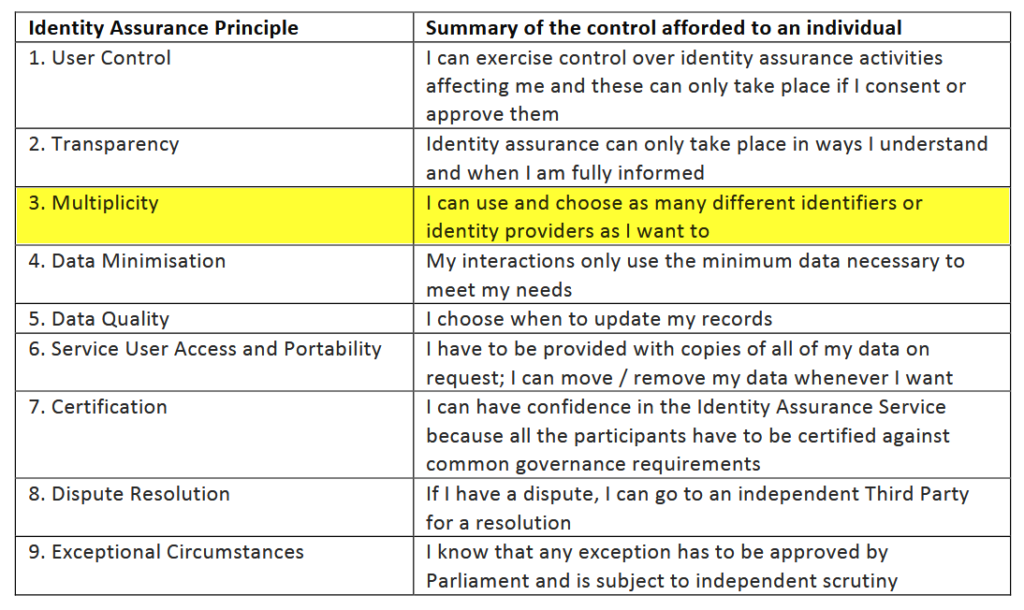
We have been asking the question on Multiplicity in the ID scheme for months now, and we understand there’s no coherent answer that will interact well with reality. That may be ‘civil service defensible’, but it is not publicly defensible. In the current Login structure, identity providers are HMPO/DVLA etc, possibly including DWP-UC, and “identifiers” means the way you login – since people are not limited to only one email address and phone number. Unless the HO wishes you to only ever have one of those, in which case, which is one way to stop Ministers using personal email addresses for official work.
Giving autonomy to a small team that won’t answer hard questions means you end up with a broken small programme later rather than a stalled-later programme now.
Perhaps ask the victims of the Carer’s Allowance scandal which they’d prefer?
____
In addition to our infrequent bulletin, you can also join our free substack to get emailed whenever we post some news or commentary.