Posts

  • Only one name, only our passport… or cough up 600 quid?

    UK border rules about passports are being changed at short notice – so short that some people have left the UK without knowing they won’t be let back in. Is the Home Office saying anyone who goes away must have their UK papers with them every time they travel? Will that extend domestically too? 

    As ever, the3million are the guinea pigs in the ID coal mine, which now covers 10 million people – and the Home Office (and others) would like it to cover everyone. 

    Now, even after you’ve proven your status and paid the Home Office for citizenship, HO is forcing you to maintain a passport before it will allow you back into the country of which you’ve become a citizen – or to pay £589 for a “certificate of entitlement” if you choose not be entered onto another of its biometric surveillance registers. (For those feeling this is OK for ‘others’, the same applies to Brits who live in countries with similarly black-and-white rules, especially if their kids were born there…)

    Surveillance Nationalism isn’t just coming for you and your kids via your passports, as it did under the Blair Government’s previous ID scheme. In the 2000s, ID cards “weren’t compulsory” (sound familiar?) but you couldn’t get a passport without being numbered, biometrically verified, and captured permanently on a National Identity Register. 

    Will the same be true in the 2020s for your ‘right’ to get a job or a place to live?

    The same is true in other contexts, where other numbers are assigned to people. Using NHS numbers for health care is one thing; reusing them as children’s identifiers is quite another, even if it has DH involvement initially. Once used in that context, giving them over to the police as ‘victim identifiers’ for child safeguarding would be entirely within the remit of DfE and the Home Office – thus making child abuse victims traceable by the police, for life. 

    While children stop being children after a while, they (hopefully) continue to be alive – and your NHS number follows you for life, available to anyone who looks you up. The very fact that someone’s number has been recorded in this context will show anyone who looks that they’re a survivor of abuse. 

    Promises made about uses one day can be torn up tomorrow 

    Wes Streeting has chosen to reuse data held by the NHS for pandemic-only purposes for other uses that he alone chooses, unilaterally revoking unequivocal promises made to ensure confidence in decision making. 

    These are things that government can do when it wants to move fast, and the civil service sees no problem with any of them because permanent officials serving temporary masters rarely feel the burden.

    Special Advisers* meanwhile want the political wins without adequate discussions across boundaries. SpAds think something is good because a Director General in DWP thinks it’s a good idea as it makes their life easier. Carer’s Allowance was fine because the DG and DWP said and still think it was a good idea – despite the independent inquiry confirming, and the Government supposedly accepting, that it wasn’t.

    The scandals of officials and SpAds who don’t give a damn, cause widespread harm and blame anyone but themselves are a drum beat, steadily increasing in pace: from Windrush, Post Office Horizon, and Grenfell to infected blood, Child Benefit ‘crackdowns’, and quarterly tax requirements.

    The system prefers to do what it wants as easily as possible, which means the costs fall on others. ‘Minor administrative cleanups’ (more pasty tax than Poll Tax) shift burdens onto the public, not the institution. As with Chip and PIN liability shifts in banking, supermarket self-checkouts and other Surveillance Capitalism wheezes, it’s what digital tools have always been used for.

    Forcing people to maintain a British passport may make things easier for the Home Office, and maybe it’s even worth doing, but rushing out a scheme without considering the entirely predictable consequences looks more like malignity than mere incompetence. When PAYE returns became monthly, government took on some of the facilitation of that via software; for quarterly tax reporting they have refused to help, and tax payers must seek commercial solutions on the open market .

    So rather than rushing into rewiring the state, maybe it’s time to take a breath, understand why and how damage is done and how it can be avoided, start to demonstrate some actual accountability, stop ‘innovating’ for innovation’s sake, and try to actually improve things for the people government is there to serve?

    ___

    *Complex decisions are increasingly made by “Advisers”, special or otherwise (Ministers acting as SpAds, PMs acting as Permanent Secretaries, Silicon Valley refugees and PMs-in-exile…) rather than by elected Public Servants acting with responsibility on behalf of the power of the Crown. And when Ministers rubber stamp “advice” – which may come from incorrigible former SpAds in Opposition too – without caring about the consequences for everyone, things tend to end in failure.

    In addition to our infrequent bulletin, you can also join our free substack to get emailed whenever we post some news or commentary.

  • Move fast, fix things, and clean up?

    On 20th January, Chief Secretary to the Prime Minister Darren Jones gave a “Move fast. Fix things” speech on rewiring Whitehall and building the new digital state. We’ve gone through it line by line, with commentary, in this document. [Original sources: video + civil service text and related interview.]

    Those who picked What3Words as the location for the Minister’s speech probably didn’t even know it has an unfixable problem which means the system promoted for emergency services sometimes sends rescuers to the wrong mountain – a minor but illustrative consequence of small underinformed teams who don’t know what they don’t know, and of a lack of awareness amongst political decision makers because PR budgets and lawyers overwhelm stories of real world victims (who may not survive institutional failure)…

    Similarly, while think tank discussion papers can sound wonderful over canapes at TBI or Labour Together HQ, they all too often ignore the real world. 

    It used to be that those mounting a coup would send a platoon to the TV or radio station – now they also need to send a laptop to the data centre. One of the first acts of the second Trump administration was to have DOGE copy anything they wanted into the data systems that Palantir had built for them. It’s no longer enough to have an absolutely loyal military, you also need a loyal technical team who care more about the mission than about citizens. 

    We note Sir Tony is building his own tech team to allow him to impose digital services on his parish in Gaza. His ‘Gaza Digital Service’ may take some lessons from this speech, but is unlikely to instil confidence in the people who are subject to it.

    The consequences of ‘two pizzas’

    Tech companies do ‘pre-mortems’, government can use the full force of law.

    NHS England’s care.data assumed it could just take opted-out data anyway (and blew up); Carer’s Allowance criminalised people who fell into the chasm between the old system and the new; DeepMind thought the law didn’t apply to them; and the calculation of Ofqual’s algorithm was that if anyone could fail then someone must fail.

    Two pizzas may be enough for a small team of committed individuals to do something for the population – where that thing is optional, and when the population gets a say. It’s nowhere near sufficient to do things to the population, especially when it can be imposed without choice. (Noting that, like ’optional’ changes on Facebook, the GOV.UK app will be updated without choice…)

    Those who got to eat pizzas at Amazon also had to see and listen to the customer support queries that came as a result of their decisions – they were not detached from that process or the effects of their decisions. Those who redesigned Carer’s Allowance weren’t required to pay attention to the whole process, so continued on entirely unaware that the process they’d designed was resulting in honest people being criminalised and having their life savings taken away.

    At population scale, the uniqueness of someone’s life amounts to little more than some complexity hidden in ‘rounding errors’ which will delay an entire project and don’t fit into a(ny) business case – and no-one who could pick up the phone to the PM will think it important enough to do so.

    Delivering improvement for all

    If you truly want to fix things, you need Challenge. Improvement, not ‘novelty’. And also robust mechanisms to ensure that Principles, not just targets, are met.

    The thing that stopped a bunch of these identity and data debacles from 2011-2024 was PCAG under the CDL; post-election it was moved to DSIT and then immediately sent a “termination letter”.

    Good intentions need systems to ensure those intentions survive – and how government talks to itself (and to industry) is very different from how it talks to the public. Compare this speech and this post with the blog post and fisking of the CSW piece we did last week…

    The fundamental question is not what the original Ministerial intent was, but what the machine below does with that intent in practice. The Official Truth has to be simple, but constituents have complex lives. 

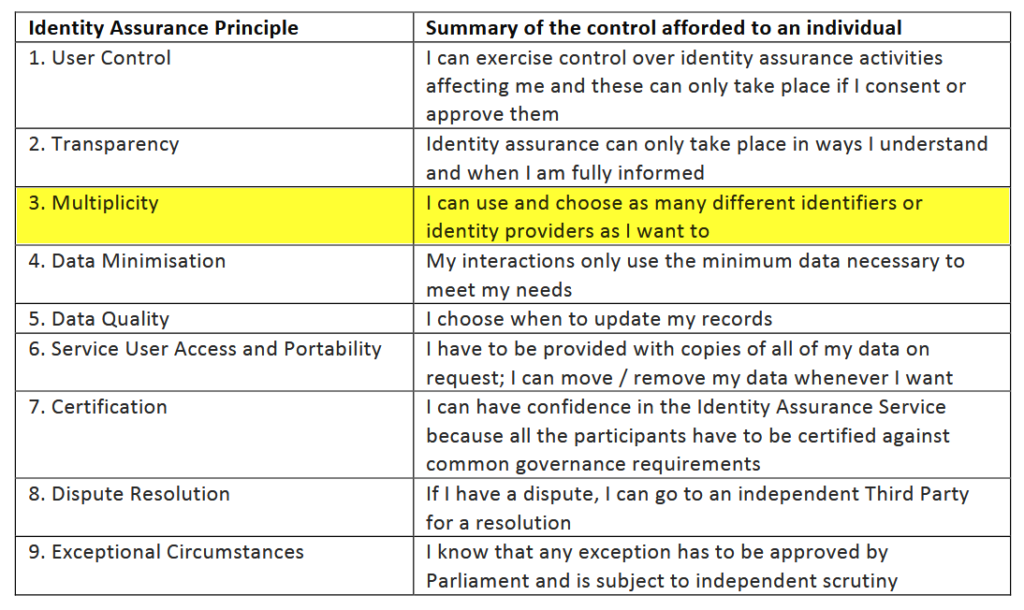
    We have been asking the question on Multiplicity in the ID scheme for months now, and we understand there’s no coherent answer that will interact well with reality. That may be ‘civil service defensible’, but it is not publicly defensible. In the current Login structure, identity providers are HMPO/DVLA etc, possibly including DWP-UC, and “identifiers” means the way you login – since people are not limited to only one email address and phone number. Unless the HO wishes you to only ever have one of those, in which case, which is one way to stop Ministers using personal email addresses for official work.

    Giving autonomy to a small team that won’t answer hard questions means you end up with a broken small programme later rather than a stalled-later programme now. 

    Perhaps ask the victims of the Carer’s Allowance scandal which they’d prefer?

    ____

    In addition to our infrequent bulletin, you can also join our free substack to get emailed whenever we post some news or commentary.
  • NO2ID Bulletin, 23 January 2026 – U-turns, delays and unanswered questions  

    Hello! A special welcome to those new to NO2ID, and to the Government’s continuing plans for ID cards. This is the first of what we expect to be our ‘monthly’ Bulletin – though the frequency may vary according to circumstances, and what the Government tries doing.  

    What do we know so far?

    (more…)
  • What has Government just said (and not said) about ID?

    Taking inspiration from Sam Trendall’s excellent summary in Civil Service World, and before it starts actually writing things down in the consultation, we thought we’d take a look at what the Government has said about its digital ID scheme.

    (If you want the ‘deep dive’, here’s a Google Doc copy of the article with added comments; if you prefer not to use Google, there’s a copy in Word format here.)

    (more…)
  • Our mailing list and our substack

    Many of you have already joined our two mailing lists.

    The NO2ID Bulletin – will get periodic updates in which we’ll give a summary of where things are, and (whenever possible) what’s likely to be coming next. We intend the Bulletin to be something you can read to stay informed, and forward to others to help keep them informed too. You can join that list in the column on the right of our website. We’ll use the list sparingly, probably sending a Bulletin every month or three – although we may send more frequent updates at busier times. Bulletins will also get posted to this website.

    NO2ID also has a free Substack which gets updated whenever we publish anything here. The Substack will potentially get multiple updates a week (or day!) at busier times, if you want to be kept bang up to date by email. Our Substack subscribers got notified when we posted about digital ID supposedly “not being mandatory”. Our public posts will always be free but there’s an option to donate via Substack when you subscribe, for those who wish to do so.

    We also accept donations directly via our website, including one-off and monthly donations via PayPal.

    We would very much like to do a 2026 version of the much-loved (and still worn!) NO2ID metal pin badges from the 2004-2011 campaign. To get things started, we’ll send the first five people who donate more than £40 a batch of five badges (when they are ready – your donations will help us do the first manufacturing run, which takes a month). [We will delete this paragraph from our website when the offer expires]

    We eagerly await the questions they won’t ask: https://www.no2id.uk/2025/upcoming-consultation/

  • No U-turn on the Government account you’ll be forced to have

    How is ID not “mandatory” if they create you an account anyway?

    In an attempt to ‘change the public mood’ before the Government begins consulting on its new ID scheme, “government sources” have briefed journalists that digital ID “will no longer be mandatory” for British citizens to prove their right to work in the UK.

    All the Home Office Right to Work checks remain, as do Right to Rent and other mandatory checks – and while government has yet to write down the details of its new ‘digital ID card’, it is rolling ahead with digital versions of your passport and driving license, and an ever-expanding requirement to register for and (only) use One Login when accessing services.

    Given how slavishly it mirrors the thinking of the Blair government-in-exile, the 2026 process is following a well-trodden path. In 2002, ID cards were first proposed as mandatory “entitlement cards” for access to services. Over the next four years, this evolved into the Blair Government’s supposedly “voluntary” ID card and National Identity Register, which you couldn’t avoid if you wanted a passport. 

    The ‘card’ this time may be a digital credential that sits on your phone, which you won’t be able to avoid if you want to use any government service once Government has “reimagined” the relationship between the citizen and the state.  

    While the headlines talk of a U-turn, the ID scheme that is already being rolled out includes “shadow” accounts which are created for everyone who doesn’t do their own identity verification for a One Login account. They are already doing this to company directors, they’re considering doing it for babies at birth and potentially for all children in school.

    Number 10 may be trying to “scrape the barnacles off the boat”, and may even drop some of the most stupid bits that their favourite think tank got them to announce without thinking through implementation. Ministers announce things with a flourish; regrets and U-turns may follow. But don’t be fooled. The ID scheme isn’t dead yet, and government still hasn’t answered really basic questions about it – like whether they’ll force married women to change their names. If it’s one account per person in their database, all linked together, what will that name on that account be?

    Ministers and officials can say different things about intent, but the underlying principle remains the same. The unchanged aspects of the ID programme continue to rewrite the relationship between citizen and state on Labour’s terms, replacing the UK’s proudly permissive culture – where one is free to act unless explicitly forbidden by law – with a ‘Papers Please’ regime of constant verification and oversight.

    And unless cast iron guarantees are written on the face of primary legislation, Blair and his acolytes will keep coming back for more…

  • Government has to write things down

    Words in speeches are one thing; delivering on those words is something else. 

    Thus far on ‘digital ID’ there has been one short speech by the Prime Minister and a few media interviews which mostly contradict each other. There’s also a mountain of papers from the Blair government-in-exile, and from other lobbyists wanting their thing.

    While commercial companies can do whatever they want and announce it later – because (mostly) no one cares – Government is different. 

    Government has to write things down. This takes time and effort. Government has to listen and hear how people respond in consultations, and think about what they say – or just ignore them all, if the consultation is a sham.

    (more…)
  • NO2ID comment on the first delay to the ID cards consultation

    Shortly after its initial announcement, Government decided “Digital ID cards” would include a physical card.

    Government has now realised that writing their consultation questions will take longer than they thought, and so has announced that the ID cards consultation is delayed into next year.

    On that point:

    Dear Ministers in the Starmer Government,

    Did spin from the ‘Blair Government-in-exile’ (and the civil service in residence) make you think ID cards were going to be easy?

    When you start to consider some of the topics the Blair Institute didn’t tell you about, NO2ID is always happy to talk through the details.

    If you’d like to get in touch, we’re at coordinator@no2id.uk

  • Child Benefit checks as the Cathedral-like Vision of “a New State”

    The HMRC Child Benefit debacle – first spotted in Northern Ireland, with tens of thousands of families across the UK being treated as fraudsters and denied money they are eligible for, based on deeply flawed Home Office data that wasn’t properly checked, as the law requires – starkly illustrates a far deeper problem with government (ab)use of our data. 

    While the current HMRC / Home Office tragedy is just the latest in a long line of examples, the underlying dynamic is clear; it’s evident in government communications too. 

    The powerful yearn to be remembered and the civil service strives to deliver what they are tasked with doing. Politicians in particular want something they will be remembered for – tearing down what they didn’t create to replace it with their ‘legacy’. The seductive lie of control encourages visions of policy cathedrals intended to glorify their time in power long after they’ve gone; edifices that often don’t outlast them by more than a year.

    Gordon Brown has his response to the 2008 financial crisis, George Osborne, austerity and omnishambles. Iain Duncan Smith has Universal Credit, Wes Streeting plans to decimate General Practice, and Tony Blair will forever have Iraq – and remains hell-bent on adding ID cards to that. 

    “Not invented here” matters to politicians more than most. The legacy state of ‘ID’ right now is a mix of providers across the public and private sectors, and a blanket refusal to allow the creation of ‘share codes’ – a ‘credential’ or ‘certificate’ that proves something about you, like a Clubcard confirms eligibility for discounts – which have long been government’s goal. 

    This is entirely a political decision. 

    The various “share codes” announced by the PM at the end of September (i.e. Right to Work and Right to Rent checks) could be delivered via existing ID providers, but a Home Office that wants to manage your identity will never approve something that allows others to build better digital services. Just as the Blair Institute assumes ID cards are a prerequisite for delivering anything they envisage, so the Home Office minimises assistance and services to anyone else running an ID system. 

    These are petty institutional games, not state building.

    “We have to build a new state and shut down the legacy state…” said Cabinet Minister Darren Jones, “…with digital ID making people’s experience of that new state fundamentally much better,” a Blair-serving, tone-deaf soundbite, misconceiving a Forth Bridge scale endeavour. The State is not something separate from the people it serves – as evidenced by the harm it causes time and again to those it overlooks or ignores – not something to be shut down on a whim. 

    Razing institutions to the ground to build new ones may seem attractive, but it’s not always even possible, much less wise. While reform is always possible, some reforms need reform after reform. 

    Those lusting for power want to reform the State in their own image, using the technology of the day. Democracy is, will and always has been about rebuilding the State for the emerging state of the world. Technology is used by power, or is deliberately chosen not to be used by power – whichever is more convenient.

    Reform(er)s often focus only on those things they care about, and neglect everything else, possibly so as to prevent another restart. And, in time, the names of those public services that leadership neglects become known as their scandals: NCC1, Carers Allowance, Child Benefit “fraud”, Windrush, Horizon and the sub-postmasters… 

    Once you shut down a service, it can be potentially impossible to restart it again – especially if you’ve sold off the buildings and made the staff redundant. (Palantir’s current worldwide ad campaign declares their services are “making Americans irreplaceable”, which is weird in the UK.

    Institutions use the technology how they want. 

    The Current Digital State

    Universal Credit is a “digital first” service, but there is still no digital service for the NCC1 form – that horrific edge case is still paper-only; the cold bureaucracy of trauma. Parents are put through pointless bureaucracy for free childcare because it ‘keeps the costs down’. The NHS National Data Opt Out requires you to use a digital service for yourself – but if you want to make the same choice for your children, you have to use a paper form and send that in.

    Institutions use the technology how they want. 

    HMRC uses Home Office records to strip honest people who haven’t left the country of Child Benefit for not returning to the country, because they never left! (That same data could be used to inform tax evasion and tax avoidance cases for people who are in the country more than they say – but that is a bit harder, so it’s ignored.)

    Politicians and their advisors came in to do a thing, having recognised or having been convinced that this change is important. They just have to hope there are no catastrophic consequences that they hadn’t considered which come due on their watch.

    It’s possible Wes Streeting didn’t mean to issue a legal Direction to NHS England that the NHS should lie to patients about him breaking the “pandemic only” promises about Covid data. It’s just what he did, because he was listening to those who would benefit from that broken promise.

    What the data is, and what the data isn’t

    The details will come out in the next few weeks, but the data the Home Office shared was not the data that HMRC thought it was. But the State did what the State does and used the most beneficial reading to make individual civil servants and politicians look good.

    HMRC wasn’t required to check other data sources, so it didn’t. (While you can receive Child Benefit without being in employment, working an hourly paid job at Tesco does strongly suggest that you haven’t left the country.)

    In a Database State driven by ID cards

    In the Database State, in a digital state linked by digital ID for “convenience” and “efficiency”, a finding by HMG that you had ‘moved abroad’ would not just automatically terminate your child benefit payments but also terminate your health care and ongoing medical treatments, terminate your repeat prescriptions and your GP registration, and remove you from waiting lists. 

    Some of that may be survivable, and some of that mess can be undone. Being taken off a waiting list can be reversed by adding you back, for example – but you are added to the back of the queue…

    Your medical records and medical notes have previously been excluded from such powers and such ‘secondary uses’, but our colleagues at medConfidential expect Wes Streeting to remove that exclusion and to include health data in the coming months when he weakens other protections there to prevent these types of mistake that can have real consequences for your health.

    Mr Streeting is also expected to remove your right to object to the Government using your medical records for any administrative purpose that they choose, as the TBI culture groupies at the just-launched “Data Alliance” want him to do.

    Many people want things to be the way they used to be; to put the world (and you) back to the way it seemed to be to them when they were a child. Others have delusions of grandeur and competence. “Take it or leave it” might be driving the TechBros and billionaire-backed influencers and their influencees right now, but while you can drive users who remain with your product, driving an electorate is a distinctly different proposition. 

  • Outside Downing Street

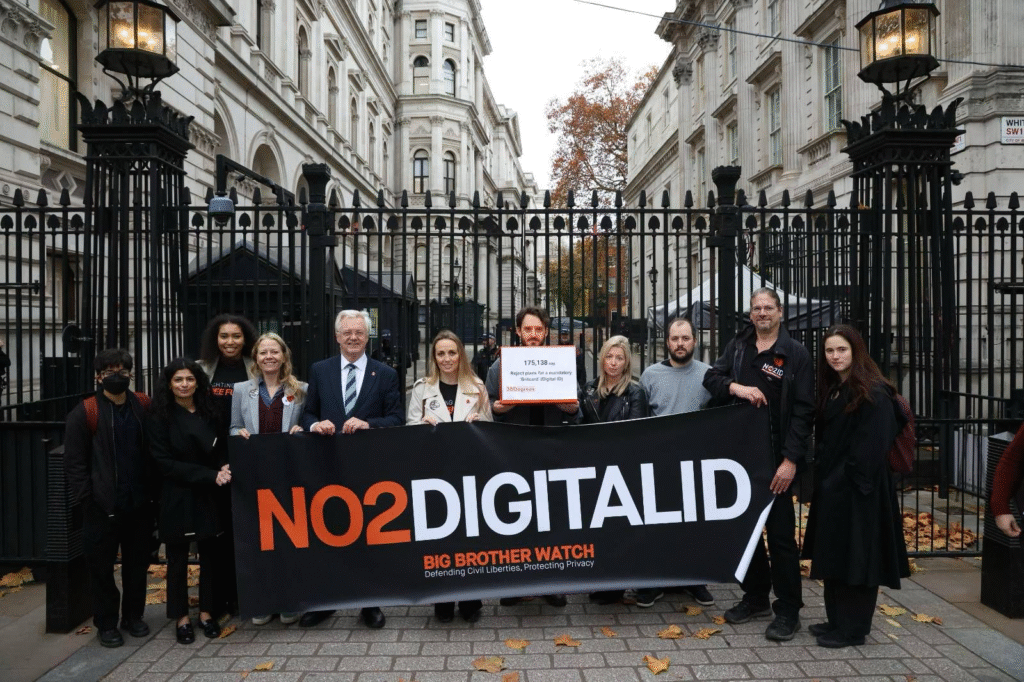
    NO2ID joined with our friends at Big Brother Watch, Liberty and the Migrants’ Rights Network, along with David Davis and Siân Berry to hand in 38 Degrees’ NO2DIGITALID petition to 10 Downing Street. (This was separate to the ongoing Parliamentary petition, which will have a Parliamentary debate on 8th December.)

    It was Remembrance Day, making the Government’s recent decision to promote its mandatory ID scheme with ‘Veteran ID cards’ seem even more tone-deaf. We did have identity cards in the UK during WWI and WWII, and very briefly under the last Labour Government – the Starmer Government might do well to recall the result of Blair’s ID ambitions last time…  

    If you would like someone from NO2ID to talk about the ID plans with your group or on your podcast, please do get in touch by sending an e-mail to hello@no2id.uk

    Big Brother Watch have posted a video of the day: